
Wholesale Liquidation Pallets for Small Businesses
Wholesale liquidation pallets for small businesses can provide a way to source products in bulk without building an inventory entirely through individual suppliers. Depending on the seller and listing, these pallets may contain home goods, tools, electronics, clothing, toys, kitchen products, and other general merchandise.
For a small business, the challenge is balancing the purchase price against the money, time, and space needed to process and sell the inventory. A large pallet may appear attractive because of its advertised retail value, but unsold products, freight charges, and additional handling can quickly reduce the potential return.
This guide explains how small businesses can choose suitable liquidation inventory, compare suppliers, calculate costs, and develop a more disciplined purchasing strategy.
Why Small Businesses Consider Wholesale Liquidation Pallets
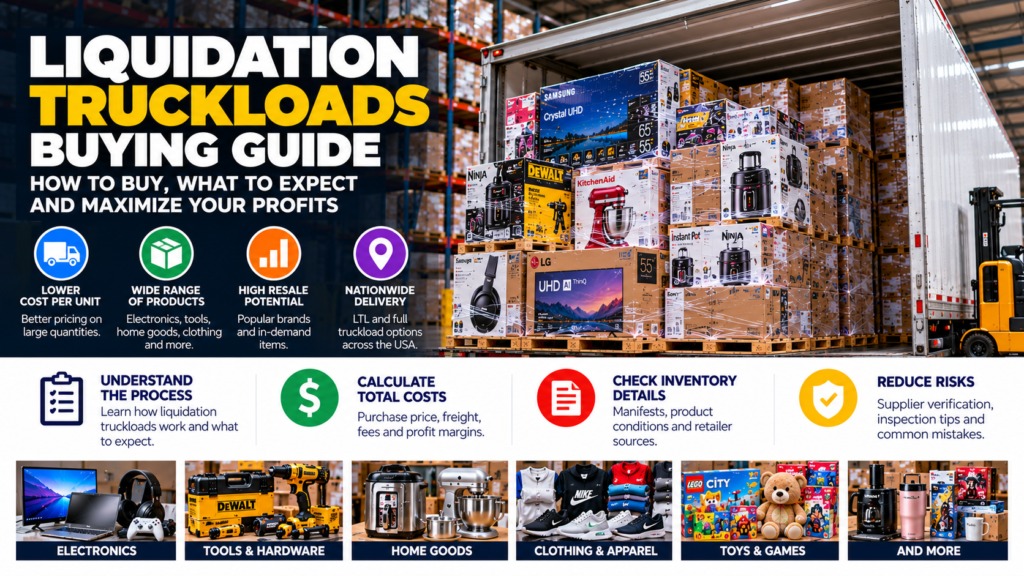
Small retailers, online sellers, market traders, and resale businesses often need inventory they can purchase within a defined budget. Liquidation pallets may provide access to bulk merchandise across several categories, depending on the supplier.
Access to Different Product Categories
Liquidation inventory can include electronics, tools, home goods, clothing, toys, and general merchandise. This variety may suit businesses that serve different customer groups or operate multiple sales channels.
However, variety is useful only when you can identify the products, evaluate their condition, and find customers for them. Choose inventory based on your business model rather than buying a pallet simply because it contains many different items.
A Way to Test New Inventory
Some small businesses use manageable purchases to test whether a new product category fits their customers. For example, a seller specialising in household products might evaluate a suitable lot containing kitchen accessories or storage products.
Treat each purchase as a business decision. Record what sells, what remains in stock, and how much time you spend processing the goods before expanding into new categories.
Potential Purchasing Flexibility
Depending on the supplier, buyers may be able to choose between individual pallets, multiple-pallet lots, and larger truckloads.
Smaller purchases can help businesses manage their cash flow while learning about a supplier’s inventory and processes. Larger orders require more working capital, storage, and sales capacity.
How to Choose the Right Liquidation Inventory
The best inventory is not necessarily the cheapest pallet. It is the inventory that fits your customers, resources, and ability to sell the products.
General Merchandise Pallets
General merchandise pallets may contain products from several retail categories. They can suit discount stores, online sellers, and market traders who have experience selling different types of goods.
The downside is that mixed inventory may require substantial sorting and research. Check the listing carefully and estimate how much of the merchandise you can realistically sell.
Home Goods and Kitchen Products
Home goods can include kitchenware, storage products, household accessories, and décor. These products may suit retailers serving customers who want practical items for everyday use.
Consider product completeness, packaging, size, and demand. Large or fragile goods can create additional storage and shipping expenses.
Tools and Hardware
Tools and hardware may appeal to DIY customers, tradespeople, and local retailers. Before buying, check the listed brands, product types, condition, and whether essential accessories are included.
For powered equipment, consider whether testing is possible and whether batteries or chargers are supplied.
Electronics
Electronics can require more inspection than simpler household products. Devices may be incomplete, damaged, locked, or untested.
Research exact model numbers, compatibility, current selling prices, and any relevant marketplace requirements. Do not estimate revenue as though every item is fully functional unless the available evidence supports that assumption.
Clothing and Apparel
Clothing pallets may contain assorted garments, footwear, and accessories. Consider sizes, seasonality, condition, storage needs, and the time required to sort and list individual items.
A large quantity of clothing is not necessarily a good purchase if the products do not fit your customers or current demand.
How Much Should a Small Business Spend?
Your purchasing budget should reflect the money available after essential business expenses, not simply the amount a supplier is willing to sell you.
Before buying wholesale liquidation pallets for small businesses, calculate how much cash you can safely commit to inventory while still covering rent, wages, utilities, marketing, taxes, and other obligations.
Also account for the time between paying for stock and receiving money from sales. Inventory may take weeks or months to sell, and some products may never sell at your expected price.
Start With a Manageable Order
If you are new to liquidation buying, consider an order size that you can afford to inspect, store, and process without disrupting your operations.
A smaller purchase can help you learn how the supplier describes its products, how freight is arranged, and how much work is required before items are ready for resale.
Once you have reliable records of actual costs and sales, you can make better-informed decisions about increasing order sizes.
Keep a Reserve for Unexpected Costs
Do not spend your entire available budget on the pallet itself. Reserve funds for freight, unloading, testing, packaging, repairs, and other expenses.
A financial buffer is particularly important when buying customer returns, unmanifested inventory, or goods with uncertain condition.
How to Evaluate a Pallet Before Buying
Careful evaluation can help small businesses avoid buying inventory that looks attractive on paper but performs poorly in practice.
Review the Manifest
A manifest may identify product names, quantities, model numbers, and condition information. Use it to research the products and estimate potential resale prices.
Check whether the manifest is guaranteed or provided for reference only. If the listing is unmanifested, account for the additional uncertainty in your budget.
Understand Product Condition
Liquidation inventory may include new overstock, shelf pulls, customer returns, refurbished goods, or salvage items. These categories have different risks and should not be treated as interchangeable.
Ask the supplier to clarify condition labels and explain whether products have been tested. Do not assume that every item is new, complete, or functional.
Research Realistic Resale Prices
Check current market prices and, where possible, completed sales for the products you expect to sell. Consider condition, competition, demand, and the fees charged by your sales platform.
Original retail prices can be useful context, but they are not a reliable prediction of your revenue.
Calculate the Full Cost
Include all expected expenses before deciding whether a pallet makes sense:
- Purchase price.
- Freight and delivery.
- Auction or transaction fees.
- Unloading and handling.
- Storage and labour.
- Testing, cleaning, and repairs.
- Packaging and fulfilment.
- Marketplace and payment fees.
- Discounts, returns, and unsellable goods.
Compare suppliers using the complete cost of acquiring and selling the inventory, rather than the advertised pallet price alone.
Where Can Small Businesses Buy Liquidation Pallets?
When researching wholesale liquidation pallets for small businesses, compare specialist wholesalers, liquidation marketplaces, and auction platforms. Verify the supplier and the terms of each listing before paying.
Explore PalletLiquidation.us
Visit PalletLiquidation.us to review the wholesale inventory offered through the website. The shop page is a useful starting point for comparing available products.
Depending on your requirements, you can also investigate these related inventory listings:
- Amazon General Merchandise Pallets
- Target General Merchandise Truckload
- Home Depot Tool and Hardware Truckload
These links represent related merchandise and bulk inventory examples. A truckload is a different purchase quantity from a single pallet, so confirm the exact quantity and terms on each live listing.
If you need more information about a specific product, use the contact page to ask about current availability, condition, quantity, and delivery costs before ordering.
Compare Other Liquidation Marketplaces
You can also research B-Stock and Liquidation.com for available liquidation inventory.
Marketplace rules, sellers, and stock vary. Some listings use auctions and may include buyer premiums, payment deadlines, or specific collection requirements.
Compare the complete delivered cost and inventory condition before choosing an offer. Do not assume that a recognised retailer’s name means the seller is the retailer itself.
How to Calculate Potential Profit
Small businesses should evaluate each pallet using realistic revenue estimates and complete cost calculations.
Suppose a pallet costs $400 and freight costs $125. Your initial landed cost is $525.
You estimate that the products you can realistically sell will generate $850 in revenue. The difference is $325 before processing, storage, selling fees, returns, and other operating costs.
If these additional costs total $200, the estimated profit would be $125, assuming your revenue estimate is achieved.
This is an illustrative example, not a typical return or a guarantee. Actual results depend on product condition, customer demand, and the costs involved.
Use this formula:
Estimated net profit = actual sales revenue − all purchase and operating costs.
Prepare a conservative scenario that accounts for damaged items, discounted products, and inventory that remains unsold. If the purchase only appears profitable under optimistic assumptions, consider a lower price or a different lot.
Shipping, Storage, and Inventory Management
A pallet purchase is only manageable if your business can receive and process it.
Before ordering, confirm the shipment’s dimensions, weight, delivery address, freight costs, and unloading requirements. Some deliveries may require a loading dock, forklift, liftgate, or additional handling services.
Plan storage space before the goods arrive. Separate inventory by category and condition, and keep untested products apart from items ready to list.
Track each product’s purchase cost, condition, listing price, sale price, and processing time. These records help you understand which categories perform well and which purchases tie up cash without generating sufficient returns.
Common Mistakes Small Businesses Should Avoid
- Buying too much too soon: Large orders can put pressure on working capital.
- Ignoring shipping costs: Freight and unloading can change the economics of a purchase.
- Relying on advertised retail value: Original prices do not guarantee resale revenue.
- Overlooking product condition: Returns and salvage items may require testing or repairs.
- Choosing unfamiliar inventory without research: Processing and selling unfamiliar products can take longer than expected.
- Failing to verify the supplier: Check business details, payment instructions, and purchasing terms.
- Neglecting inventory records: Without tracking costs and sales, it is difficult to judge whether a purchase worked.
- Ignoring sales capacity: Inventory must be processed and sold, not merely stored.
A consistent buying process helps small businesses compare offers and learn from each purchase.
Frequently Asked Questions
Are wholesale liquidation pallets suitable for small businesses?
They can be suitable when the inventory fits the business’s budget, storage space, customer demand, and ability to process the products. Buyers should evaluate the total cost before purchasing.
How many pallets should a small business buy?
There is no universal quantity. Choose an order size based on available capital, storage capacity, sales history, and how much inventory your team can process.
Can beginners make money reselling liquidation pallets?
It is possible, but profit is not guaranteed. Beginners should research suppliers, understand product condition, calculate all costs, and start with a manageable purchase.
Are manifested pallets better for small businesses?
A manifest can help buyers assess expected contents and research resale prices. Its value depends on its accuracy and the supplier’s terms. Unmanifested pallets generally involve greater uncertainty.
What should a small business check before ordering?
Review the listing, condition information, supplier details, payment terms, shipping costs, and policies for discrepancies. Estimate potential revenue conservatively before committing funds.
Choosing Wholesale Liquidation Pallets for Small Businesses
Choosing wholesale liquidation pallets for small businesses starts with understanding your customers, budget, and available storage space. The right inventory should match the products your business can realistically sell.
When comparing wholesale liquidation pallets for small businesses, review the product description, merchandise condition, quantities, and shipping charges before placing an order.
Wholesale liquidation pallets for small businesses can contain general merchandise, tools, electronics, home goods, clothing, and other products. Check the specific listing to understand what is included rather than assuming every pallet contains the same inventory.
Before purchasing wholesale liquidation pallets for small businesses, research realistic resale prices and calculate the complete cost, including freight, handling, testing, packaging, and selling fees.
Small retailers considering wholesale liquidation pallets for small businesses should start with an order size they can afford to process and store. Larger purchases can tie up working capital if products take longer than expected to sell.
Comparing wholesale liquidation pallets for small businesses from different suppliers can help you evaluate pricing, condition information, delivery options, and purchasing terms.
The best wholesale liquidation pallets for small businesses are not necessarily the cheapest. Look for inventory that fits your sales channels and offers a reasonable potential return after expenses.
Before ordering wholesale liquidation pallets for small businesses, verify the supplier’s details and ask questions about missing items, damaged products, and the terms of the sale.
For businesses exploring wholesale liquidation pallets for small businesses, keeping accurate records of purchase prices, freight costs, sales, and unsold stock can improve future buying decisions.
Visit PalletLiquidation.us and browse the shop page to review available inventory. Confirm each listing’s current availability, contents, condition, and delivery costs before purchasing.
Ultimately, wholesale liquidation pallets for small businesses can be a useful sourcing option when the inventory matches your customers and your business can manage the full cost of buying and reselling it.
Final Thoughts
Wholesale liquidation pallets for small businesses can provide a way to source inventory in bulk, but success depends on choosing products that fit your customers and managing the full cost of buying and selling them.
Start with a realistic budget, verify the supplier, review the merchandise condition, and calculate shipping and operating expenses before placing an order. Choose a quantity your business can process and sell without putting essential cash flow at risk.
To explore available wholesale inventory, visit PalletLiquidation.us and browse the shop page. Check the details of each listing and confirm current availability, quantity, condition, and delivery terms before purchasing.
The best purchase is not necessarily the largest pallet or the one with the highest advertised retail value. It is the inventory that your business can manage, sell responsibly, and evaluate against realistic financial goals.
