
Customer Returns Pallets: Risks, Costs and Resale Potential
Customer returns pallets can provide resellers with access to bulk merchandise from retail returns, but they require careful evaluation before purchase. Depending on the supplier and individual listing, a pallet may contain electronics, small appliances, home goods, tools, clothing, toys, and other products returned by customers.
The opportunity is to acquire suitable inventory at a price that leaves room for inspection, processing, and resale expenses. The challenge is that returned products can vary considerably in condition. Some may be unused, while others may have missing accessories, cosmetic damage, functional faults, or incomplete packaging.
This guide explains how customer returns pallets work, what to inspect before buying, how to calculate potential profit, and how to decide whether returned inventory fits your resale business.
What Are Customer Returns Pallets?
Customer returns pallets are bulk lots of merchandise that customers have returned to retailers or sellers. These products may enter liquidation channels because they cannot be resold through the original retailer’s normal process, because inventory needs to be cleared, or because the seller is managing returned stock in bulk.
The reason for a return can vary. A customer may have changed their mind, ordered the wrong size, received a damaged item, found a product unsuitable, or reported a functional problem.
A returned product is not automatically defective, but it should not automatically be treated as new or fully functional either.
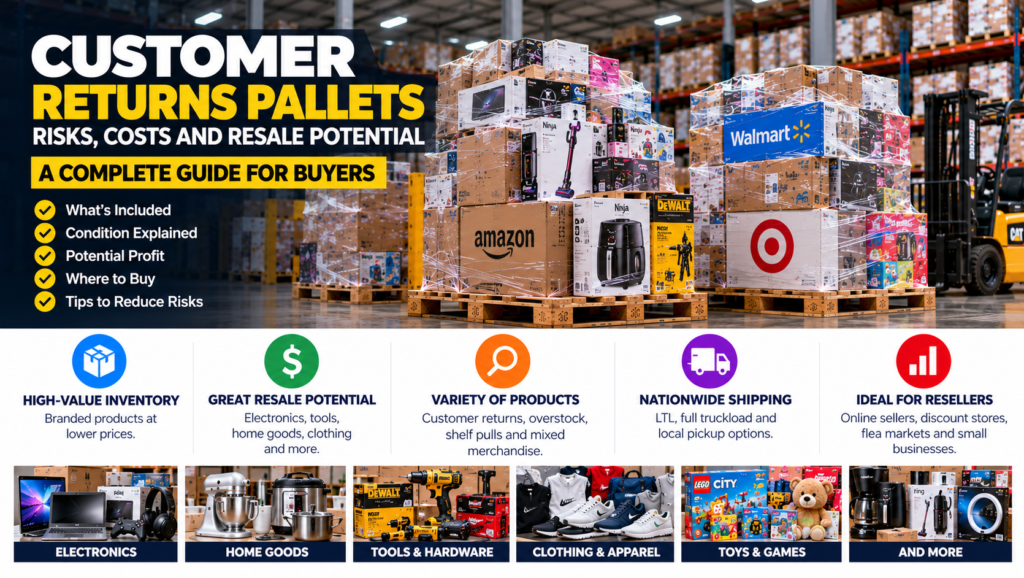
Depending on the listing, customer returns pallets may include:
- Electronics and accessories.
- Small household appliances.
- Kitchenware and home goods.
- Tools and hardware.
- Clothing, footwear, and accessories.
- Toys, games, and children’s products.
- Mixed general merchandise.
The actual contents depend on the supplier, source, and condition of the inventory. Review the listing rather than assuming every pallet contains the same products.
Why Do Retailers Sell Customer Returns in Bulk?
Handling returned merchandise individually can require inspection, repackaging, restocking, and additional administration. Some returned products may be unsuitable for resale through the retailer’s ordinary sales channels.
Liquidation provides one way for businesses to move surplus or returned inventory in larger quantities.
For resellers, these lots can create opportunities to source products at a discounted acquisition cost. However, the discount must compensate for the uncertainty, labour, and expenses associated with evaluating and reselling the goods.
The advertised retail value alone does not establish whether a pallet is a good purchase.
What Conditions Can You Expect?
Understanding product condition is one of the most important parts of evaluating customer returns pallets.
Unopened or Apparently Unused Products
Some returns may appear unused or retain their original packaging. Even then, check whether the packaging is sealed, whether essential components are included, and whether the item can be sold in the condition described.
Packaging alone is not proof that a product is new or functional.
Open-Box Merchandise
Open-box items may have been removed from their packaging for inspection or use. They might be complete and functional, but accessories, manuals, or protective materials may be missing.
Check each listing’s condition definitions and the seller’s description of the merchandise.
Tested and Refurbished Products
Some liquidation inventory may be tested, repaired, or refurbished. The exact meaning of these terms depends on the supplier.
Ask what testing was performed, whether repairs were completed, and whether any warranty or return protection applies. Do not assume all refurbished items have undergone the same inspection process.
Untested Customer Returns
Untested returns carry greater uncertainty. A product may be functional, incomplete, damaged, or faulty.
Your valuation should reflect the cost of testing and the possibility that some items cannot be resold. If the seller cannot confirm the condition, avoid pricing the pallet as though every item works.
Damaged or Salvage Merchandise
Salvage inventory may contain broken products, missing components, or items that require significant repair. Some goods may only be suitable for parts, recycling, or disposal.
Only consider salvage inventory if you understand the risks and have a practical plan for handling the products.
Are Customer Returns Pallets Worth Buying?
Customer returns pallets can be worth considering when the purchase price, inventory mix, condition information, and expected resale revenue support a reasonable business case.
Potential Advantages
Discounted acquisition costs: Returned merchandise may be offered at a lower purchase price than comparable new inventory.
Varied product selection: Mixed lots can contain several categories, allowing resellers to test different sales channels.
Multiple resale opportunities: Depending on condition and platform rules, suitable products may be sold individually, bundled, or offered through local retail channels.
Potential to build product knowledge: Repeated experience inspecting returned goods can help buyers learn which categories and condition profiles suit their business.
These advantages are not guaranteed. A low acquisition cost cannot compensate for every product being unsellable or expensive to repair.
Important Disadvantages
Customer returns can require more work than new overstock. Buyers may need to test products, source missing accessories, clean merchandise, repair faults, and handle customer questions.
Inventory can also be inconsistent. A pallet may contain several valuable products alongside items that are difficult to sell.
Before buying, consider whether you have the time, equipment, expertise, and cash flow to process the inventory.
How to Evaluate Customer Returns Pallets Before Buying
Use a consistent checklist to assess each opportunity.
1. Review the Manifest
A manifest may list product names, quantities, model numbers, and condition information. Use it to identify products worth researching and estimate a realistic resale range.
Check whether the manifest is guaranteed or provided for reference only. It may not guarantee that every listed item is present or functional.
If the pallet is unmanifested, allow for greater uncertainty and adjust your maximum purchase price accordingly.
2. Check the Condition Description
Find out whether the goods are tested, untested, open-box, refurbished, damaged, or sold as-is.
Ask the supplier to explain any unclear condition terms. Do not rely on vague descriptions when the condition will materially affect your expected revenue.
3. Research Product Demand
Use product names and model numbers to research current selling prices and evidence of customer demand.
Consider competition, product age, compatibility, seasonality, shipping costs, and the selling platform’s policies. Original retail value should not be treated as expected resale revenue.
4. Estimate the Work Required
Consider how much time it will take to sort, test, clean, repair, photograph, and list the goods.
Electronics and appliances may require more inspection than simple household accessories. Clothing may require sorting by size and condition. Large or fragile products may require extra storage and handling.
Include these costs in your calculations before purchasing.
5. Verify the Supplier
Check the business identity, contact information, payment instructions, delivery arrangements, and policies for discrepancies or damaged goods.
Be cautious of pressure to pay immediately, unclear listing terms, or promises of guaranteed profit. Keep records of the listing, invoice, and communications.
Where to Buy Customer Returns Pallets in the USA
When researching customer returns pallets, compare liquidation wholesalers, marketplace listings, and auction platforms. Verify the merchandise source and the seller’s terms before placing an order.
Explore PalletLiquidation.us
Start with PalletLiquidation.us and browse the shop page to review current wholesale inventory.
You can also investigate related merchandise listings, such as:
These are related general merchandise or electronics inventory examples, not a guarantee that each listing contains customer returns. Confirm the exact contents, condition, quantity, and availability on the live product page.
If you need additional information, use the contact page to ask about a specific listing before ordering.
Compare Other Liquidation Marketplaces
You can also research B-Stock and Liquidation.com for available liquidation inventory.
Listings and purchasing arrangements vary. Some lots are sold by auction, and additional buyer fees, freight charges, or collection requirements may apply.
Compare the total delivered cost, merchandise condition, seller information, and purchasing terms rather than selecting an offer based only on its advertised retail value.
How to Calculate Profit on Returned Inventory
Before buying, calculate the full cost of acquiring and reselling the products.
Include the purchase price, auction fees, freight, unloading, storage, testing, cleaning, repairs, packaging, marketplace fees, and expected losses from unsellable products.
Example Profit Calculation
Suppose a customer returns pallet costs $350 and freight costs $125. Your initial landed cost is $475.
After reviewing the inventory, you estimate that the products you can realistically sell will generate $800 in revenue. That leaves $325 before testing, repairs, selling fees, and other operating costs.
If those additional costs total $200, the estimated profit is $125, assuming the revenue estimate is achieved.
This is an illustrative example, not a typical return or a guarantee. Actual results can be lower or higher.
Use this formula:
Estimated net profit = actual sales revenue − all purchase and operating costs.
Prepare a conservative scenario that accounts for unsellable goods, discounted products, and unexpected repairs. If the purchase only makes sense when nearly every product sells at the expected price, consider a lower offer or a different lot.
Shipping, Storage, and Handling
Customer returns pallets need a suitable receiving and processing plan. Before ordering, confirm the pallet’s dimensions, weight, collection location, delivery address, and freight costs.
Check whether the delivery site needs a loading dock, forklift, liftgate, or additional unloading services. Residential and limited-access locations may incur additional fees.
Once the shipment arrives, separate products by category and condition. Keep untested goods apart from items that are ready to list, and document any damage or discrepancies.
Good inventory organisation can reduce processing time and make it easier to calculate the actual performance of each purchase.
Common Mistakes to Avoid
When purchasing customer returns pallets, avoid these mistakes:
- Assuming every item works: Returns may be faulty, incomplete, or untested.
- Trusting retail value alone: Original prices do not guarantee resale revenue.
- Ignoring testing and repair costs: These expenses can reduce margins.
- Overlooking shipping charges: Freight can change the overall economics of a purchase.
- Buying too much inventory: Large lots require storage, time, and working capital.
- Skipping supplier verification: Check business information and terms before payment.
- Failing to document condition: Accurate records support responsible resale listings and help manage disputes.
A disciplined evaluation process helps you make more informed decisions and avoid purchases based on unrealistic expectations.
Frequently Asked Questions
Are customer returns pallets profitable?
They can be, but profit is not guaranteed. Results depend on purchase price, product condition, resale demand, freight, processing expenses, and the proportion of inventory that can actually be sold.
Are customer returns pallets suitable for beginners?
They may suit beginners who start with a manageable order, understand the risks, and have time to inspect and process the goods. Unmanifested or untested lots can be especially challenging for inexperienced buyers.
Do customer returns pallets contain damaged items?
They can. Depending on the listing, a pallet may include unused, opened, incomplete, damaged, or untested products. Confirm the condition description with the supplier before buying.
Are manifested pallets better than unmanifested pallets?
A manifest can provide useful information about expected contents and help you estimate resale value. Its usefulness depends on its accuracy and the supplier’s terms. Unmanifested pallets generally involve more uncertainty.
How can I reduce the risks of buying customer returns pallets?
Research the supplier, review the listing, check condition information, calculate the complete cost, and estimate resale revenue conservatively. Avoid committing more money than your business can afford to tie up in inventory.
Final Thoughts
Customer returns pallets can offer sourcing opportunities for resellers who understand product condition, research demand, and account for the costs of testing and processing merchandise. The main challenge is uncertainty: a discounted pallet may still be a poor purchase if too many items are damaged, incomplete, or difficult to sell.
Before ordering, review the manifest where available, verify the supplier, calculate the full landed cost, and choose inventory that suits your business and sales channels.
To explore wholesale inventory, visit PalletLiquidation.us and browse the shop page. Confirm the contents, condition, current availability, and shipping terms of each listing before purchasing.
The best buying decision is not the pallet with the highest advertised retail value. It is the one whose realistic resale potential justifies the total cost and risk.
