
Walmart Liquidation Pallets: What Buyers Need to Know
Walmart liquidation pallets are a product-sourcing option for resellers looking to purchase retail merchandise in bulk. Depending on the source and listing, these pallets may contain general merchandise, household products, electronics, tools, clothing, toys, and customer returns.
For resellers, the opportunity is to acquire suitable inventory at a cost that leaves room for expenses and potential profit. However, not every pallet offers the same value. Product condition, inventory accuracy, shipping costs, supplier terms, and customer demand all influence whether a purchase makes sense.
This guide explains how Walmart-related liquidation inventory works, where to research available lots, what to check before buying, and how to calculate the potential return on your investment.
What Are Walmart Liquidation Pallets?
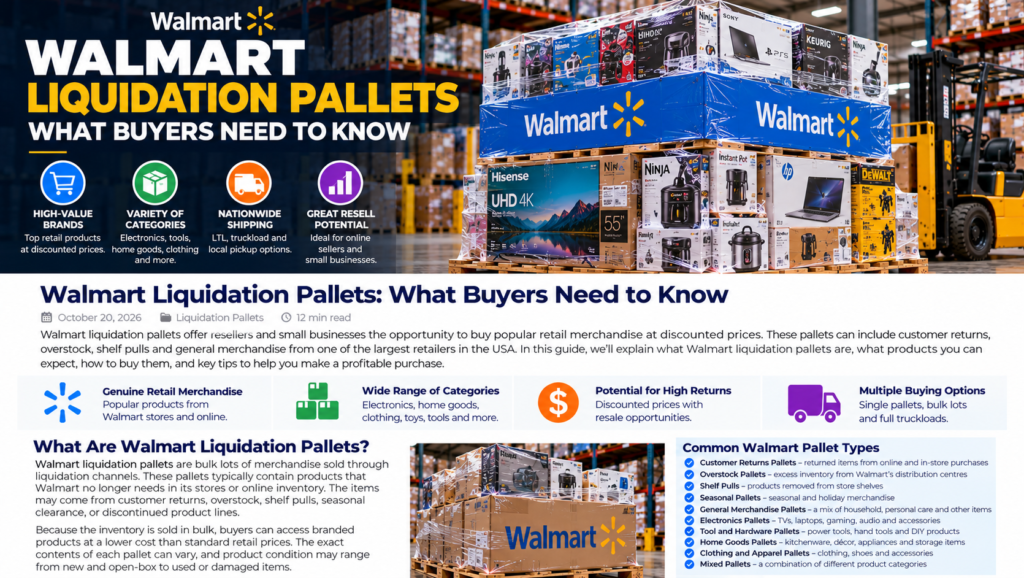
Walmart liquidation pallets generally refer to bulk lots of merchandise associated with Walmart retail inventory or liquidation channels connected to its goods. Depending on the seller and sourcing arrangement, inventory may include customer returns, excess stock, shelf pulls, discontinued products, or general merchandise.
The exact contents depend on the individual listing. Some pallets contain a single product category, while others combine different types of goods.
Common categories buyers may encounter include:
- General merchandise: Household products, accessories, toys, and everyday items.
- Electronics: Selected consumer electronics, accessories, and small appliances.
- Tools and hardware: Hand tools, power tools, and home improvement products.
- Home goods: Kitchenware, storage products, décor, and household essentials.
- Clothing and apparel: Clothing, shoes, and fashion accessories.
- Customer returns: Products returned by customers, with condition varying between items.
It is important to distinguish merchandise associated with Walmart from inventory sold directly by Walmart. Independent liquidation companies and marketplace sellers may offer Walmart-related goods, but not every seller is an official Walmart liquidation channel.
Always verify the seller, the inventory source, and the terms of the specific listing before paying.
Why Do Resellers Buy Walmart Liquidation Pallets?
Liquidation inventory can appeal to small businesses, online sellers, discount retailers, and experienced wholesale buyers. The attraction is the possibility of acquiring a group of products at a lower cost than purchasing equivalent items individually.
Access to Different Merchandise Categories
A mixed pallet may offer several product types in one purchase. This can be useful for resellers who operate discount stores, online shops, flea-market stalls, or multiple sales channels.
However, variety also creates work. Products may require sorting, testing, cleaning, photographing, pricing, and separate listings. Choose a category that fits your available time and experience.
Bulk Inventory for Resale
Buying in bulk can reduce the time spent sourcing individual products. It may also provide enough stock to test customer demand across several items.
Nevertheless, the quantity of merchandise alone does not determine value. A large pallet of slow-moving products can tie up cash and storage space. Evaluate what you can realistically sell rather than focusing only on the number of items.
Opportunities for Different Business Sizes
New resellers may prefer smaller lots that are easier to inspect and process. Established businesses may consider larger orders when they have sufficient working capital, warehouse space, and sales capacity.
The right purchase size depends on your business model, not simply on the size of the advertised discount.
Where Can You Buy Walmart Liquidation Pallets?
If you are researching Walmart liquidation pallets, compare specialist liquidation wholesalers, established liquidation marketplaces, and auction platforms. The seller’s identity and the source of the merchandise matter as much as the advertised price.
1. Research Liquidation Wholesalers
Start by reviewing the inventory offered through PalletLiquidation.us. Browse the shop page and check the available listings to identify products that fit your budget and resale strategy.
Before purchasing a specific Walmart-related lot, confirm the exact merchandise source, current availability, product condition, quantity, and shipping arrangements. Do not assume that every listing on a liquidation website contains Walmart merchandise.
You can also use the website’s contact page to ask questions about a listing before placing an order.
2. Compare Established Liquidation Marketplaces
Another option is to research established platforms such as B-Stock and Liquidation.com.
These platforms may offer different sellers, merchandise categories, auction formats, and purchasing requirements. Availability changes, so search the current listings and check whether the inventory is actually connected to Walmart before bidding or buying.
Review buyer fees, payment deadlines, collection rules, freight charges, and the seller’s condition descriptions. A familiar retailer’s name in a listing does not automatically mean the retailer is the direct seller.
3. Consider Local Wholesale Warehouses
Local liquidation warehouses may be useful if you want to inspect available inventory or arrange collection. Before visiting, verify the business’s address, opening arrangements, purchasing policies, and whether the stock you want is available.
Compare the final cost with online offers. Local collection can reduce some transport expenses, but inspection time, loading requirements, and vehicle capacity should also be considered.
How to Evaluate a Walmart Liquidation Pallet Before Buying
A careful review can help you avoid purchases based on unrealistic expectations.
Check the Manifest
A manifest may identify the products, quantities, model numbers, or stated conditions included in a pallet. Use it to research resale prices and identify products that may be suitable for your customers.
However, a manifest does not necessarily guarantee that every item is present, complete, or functional. Read the supplier’s terms to understand how discrepancies are handled.
If a pallet is unmanifested, assume there is greater uncertainty and adjust your maximum purchase price accordingly.
Understand Product Condition
Liquidation inventory may include different condition categories:
- Overstock: Excess inventory that was not sold through the original retail channel.
- Shelf pulls: Items removed from retail shelves, potentially with opened packaging or missing labels.
- Customer returns: Goods returned by customers for various reasons.
- Refurbished items: Products that have undergone some form of repair or restoration, depending on the seller’s description.
- Salvage merchandise: Items that may be damaged, incomplete, or unsuitable for ordinary resale.
These labels can mean different things across suppliers. Ask for clarification if the listing does not explain its condition categories.
Do not advertise a product as new or fully working unless you have sufficient evidence to support that description.
Research Resale Demand
Before buying, research the products that appear in the listing. Compare current selling prices, competition, product condition, and evidence of actual demand.
For branded electronics and tools, check model numbers and compatibility. For clothing and home goods, consider seasonality, sizes, storage needs, and the likely selling price.
Original retail value is not the same as achievable resale value.
Verify the Supplier
Check business details, contact information, payment instructions, shipping terms, and policies for damaged or missing merchandise.
Be cautious if a seller refuses to explain the listing, pressures you to pay immediately, or makes unusually strong profit guarantees. Keep records of the listing and the terms agreed before payment.
How Much Do Walmart Liquidation Pallets Cost?
There is no single price for Walmart liquidation pallets. Costs vary by category, quantity, condition, demand, and the seller’s pricing method. Auction lots may also involve buyer premiums and other fees.
The total cost can include:
- Pallet or lot purchase price.
- Auction or transaction fees.
- Freight and delivery charges.
- Unloading and handling.
- Storage and inventory processing.
- Testing, cleaning, or repairs.
- Packaging and selling fees.
Compare the complete delivered cost instead of selecting a lot based only on its advertised price.
Calculate Your Potential Profit
Suppose a hypothetical pallet costs $450 and shipping costs $150. Your initial landed cost is $600.
If the items generate $950 in sales, the difference is $350 before testing, storage, selling fees, returns, and other operating expenses. If those additional costs total $200, the estimated profit is $150.
This is an illustration, not a typical return or a guarantee. Actual results depend on the products, their condition, and whether the estimated sales are achieved.
Use this formula:
Estimated net profit = sales revenue − all purchase and operating costs.
Prepare a conservative estimate that accounts for damaged items, products that do not sell, discounts, and customer returns. If a purchase only appears profitable under optimistic assumptions, consider a lower offer or a different lot.
Shipping and Delivery Considerations
Freight can significantly affect the cost of liquidation inventory, especially when buying from another state.
Before placing an order, confirm the pallet’s dimensions, weight, pickup location, delivery address, and estimated transit time. Ask whether delivery requires a loading dock, forklift, liftgate, or additional handling services.
Residential and limited-access locations may incur additional fees. Make sure the delivery site can safely receive and unload the shipment.
Also consider what happens when the pallet arrives. You will need enough space to inspect the goods, separate products by condition, and prepare inventory for sale.
Common Mistakes to Avoid
When buying Walmart-related liquidation inventory, avoid these common mistakes:
- Assuming all merchandise is new: Returns and salvage products may require inspection or repair.
- Trusting retail values alone: Original prices do not guarantee customer demand or resale revenue.
- Ignoring additional fees: Freight, buyer premiums, and selling costs can reduce margins.
- Skipping supplier checks: Verify the seller and the terms before paying.
- Buying more than you can process: Large orders require space, cash flow, and time.
- Ignoring product restrictions: Check marketplace policies and applicable safety requirements.
- Failing to plan the resale channel: Know where you intend to sell before buying the inventory.
A disciplined sourcing process can help you compare offers and make decisions based on realistic business costs.
Frequently Asked Questions
Are Walmart liquidation pallets profitable?
They can be, but profitability is not guaranteed. Results depend on purchase price, product condition, demand, shipping, selling fees, and how much of the inventory can be sold.
Can beginners buy Walmart liquidation pallets?
Yes, but beginners should start with a manageable order size, research the seller, understand condition descriptions, and calculate total costs before committing money.
Do Walmart liquidation pallets contain only Walmart products?
Not necessarily. The contents depend on the listing and sourcing arrangement. Verify the inventory source and product details with the seller rather than assuming every item originated from Walmart.
Are manifested pallets better than unmanifested pallets?
A manifest can help you assess expected contents and estimate potential resale value. Its usefulness depends on the accuracy of the information and the supplier’s terms. Unmanifested lots generally involve more uncertainty.
Can I buy Walmart liquidation pallets online?
You can research liquidation wholesalers and marketplaces online. Before purchasing, confirm the seller’s identity, the merchandise source, the current listing, and the complete delivery cost.
Final Thoughts
Walmart liquidation pallets may offer an inventory-sourcing opportunity for resellers who understand the merchandise, calculate costs carefully, and choose suppliers with transparent terms. The key is to evaluate the specific lot rather than assuming that a recognised retailer’s name guarantees quality or profit.
Compare the inventory, review product condition, estimate realistic resale prices, and include shipping and operating costs in your calculations. Start with a manageable purchase and use actual sales results to improve your future buying decisions.
To explore wholesale inventory, visit PalletLiquidation.us and browse the shop. Confirm the details of each listing before placing an order.
