

Tool Liquidation Pallets can give resellers, retailers, contractors, and small businesses access to bulk tool inventory at wholesale prices. Instead of purchasing individual tools one at a time, buyers can source larger quantities of merchandise through a single pallet purchase.
Depending on the supplier and inventory source, Tool Liquidation Pallets may contain power tools, hand tools, accessories, batteries, chargers, tool cases, and other hardware products. Inventory can also vary by brand, condition, quantity, and product category.
For businesses that understand how liquidation inventory works, Tool Liquidation Pallets can become an important sourcing option. However, buyers should evaluate the actual merchandise, total acquisition cost, condition, and potential resale channels before placing an order.
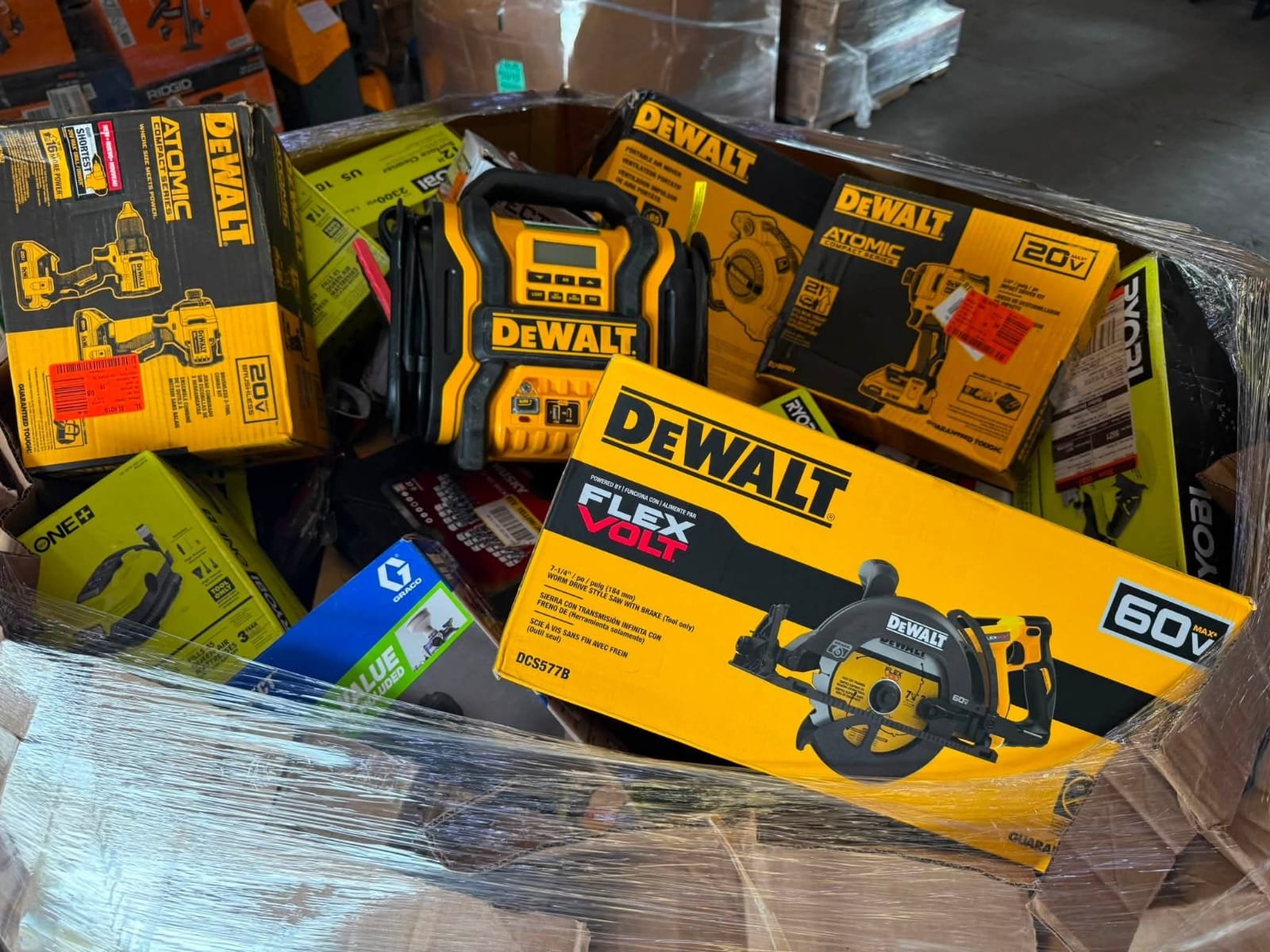
What Are Tool Liquidation Pallets?
Tool Liquidation Pallets are bulk shipments of tools that are typically sold below traditional retail pricing because the inventory is being cleared, liquidated, overstocked, returned, or moved through a wholesale channel.
The contents can vary significantly from one pallet to another.
A pallet might include:
- Cordless drills
- Impact drivers
- Circular saws
- Reciprocating saws
- Grinders
- Sanders
- Screwdrivers
- Pliers
- Wrenches
- Socket sets
- Measuring tools
- Batteries
- Chargers
- Tool accessories
- Carrying cases
Some Tool Liquidation Pallets are focused on particular brands or categories, while others contain a broader assortment of merchandise.
This variety means buyers should examine each available load individually instead of assuming every liquidation pallet contains the same products.
Why Buy Tool Liquidation Pallets?
There are several reasons businesses purchase Tool Liquidation Pallets.
Lower Wholesale Acquisition Costs
Liquidation inventory can sometimes be acquired below conventional wholesale or retail pricing. The lower acquisition cost can give resellers more flexibility when establishing selling prices.
However, the purchase price should never be the only consideration.
Shipping, testing, repairs, packaging, marketplace fees, storage, and other expenses can affect your actual cost.
Large Inventory in One Purchase
Tool Liquidation Pallets can provide dozens or hundreds of products depending on the load.
For a reseller, this can create multiple listings and potential sales opportunities from one inventory purchase.
Multiple Product Categories
A mixed liquidation load may contain different types of tools.
This can help businesses serve customers with different needs instead of concentrating on one product category.
Resale Potential
Tools can appeal to contractors, tradespeople, mechanics, DIY customers, homeowners, maintenance workers, and other buyers.
A reseller can potentially separate the inventory into individual listings, bundles, or wholesale lots.
Where Does Liquidation Tool Inventory Come From?
Understanding the source of the merchandise is important when evaluating Tool Liquidation Pallets.
Potential sources include:
- Customer returns
- Overstock
- Shelf pulls
- Store closures
- Warehouse surplus
- Discontinued inventory
- Excess inventory
- Open-box products
- Business liquidation
The inventory source can affect product condition and the amount of inspection required after delivery.
For example, new overstock merchandise may require less preparation than customer-return inventory.
What Can Be Inside Tool Liquidation Pallets?
The exact contents depend on the specific pallet.
Some loads may focus heavily on power tools, while others may contain a combination of hand tools and accessories.
Potential inventory includes:
Power Tools
Power tools can include drills, impact drivers, saws, grinders, sanders, rotary tools, and other powered equipment.
Hand Tools
Hand-tool inventory may include wrenches, pliers, screwdrivers, ratchets, sockets, clamps, and measuring equipment.
Accessories
Accessories can include drill bits, saw blades, batteries, chargers, cases, attachments, and other supporting products.
Before purchasing Tool Liquidation Pallets, review the product description carefully to determine what categories are actually represented.
Brand Names Can Affect Resale Demand
Brand recognition can influence what customers are willing to pay for a tool.
Well-known manufacturers may have established customer bases, especially among contractors and professional users.
Milwaukee inventory, for example, can attract customers looking specifically for compatible tools, batteries, and accessories. Buyers can review the Milwaukee Tool Pallets collection when researching available inventory.
DeWalt is another recognizable tool brand frequently searched by professional and DIY customers. A buyer researching DeWalt inventory can review the DeWalt tool pallet guide.
When evaluating Tool Liquidation Pallets, consider the brand mix alongside quantity and condition.
New vs. Returned Liquidation Tools
Not all liquidation inventory has the same condition.
Possible conditions include:
- New
- Open box
- Shelf pull
- Customer return
- Used
- Tested
- Untested
- Damaged
- Mixed condition
A pallet containing new merchandise may require less preparation, while customer returns can require inspection, testing, cleaning, replacement parts, or repairs.
This is why condition should be included in your cost calculations.
How to Evaluate Tool Liquidation Pallets
Before purchasing Tool Liquidation Pallets, create a checklist and review the available information carefully.
1. Review the Product Description
Identify the tool categories, brands, estimated quantity, condition, and any other information provided by the supplier.
Do not rely only on a product title.
2. Check for a Manifest
A manifest can make it easier to understand what you are buying.
Depending on the supplier, a manifest may include:
- Product names
- Model numbers
- Quantities
- Brands
- Estimated retail values
- Condition information
A manifested load may provide more information for planning, but you should still review the terms and condition descriptions.
3. Calculate Your Landed Cost
The purchase price is only part of your investment.
Your landed cost can include:
Pallet price + shipping + taxes + handling + inspection + repairs + packaging
For example, if your pallet costs $1,200 and shipping costs $300, your initial acquisition cost is already $1,500 before other expenses.
Understanding the landed cost helps you determine realistic resale prices.
4. Estimate the Sellable Percentage
Not every liquidation item should automatically be treated as ready-to-sell inventory.
Separate expected inventory into categories such as:
- Ready to sell
- Requires testing
- Requires cleaning
- Requires minor repair
- Parts or accessories
- Unsellable
This provides a more realistic view of your potential inventory.
How to Calculate Resale Potential
When buying Tool Liquidation Pallets, avoid calculating potential profit using retail prices alone.
Instead, research actual market prices for comparable products.
Consider:
- Brand
- Model
- Condition
- Accessories
- Battery availability
- Charger availability
- Current demand
- Competition
- Selling fees
- Shipping costs
A tool advertised at a high retail price does not necessarily sell for that amount in the secondary market.
Use realistic selling prices when estimating your potential revenue.
Example of a Liquidation Calculation
Imagine a pallet costs $2,000 and contains 100 tools.
Your initial average acquisition cost would be:
$2,000 ÷ 100 = $20 per item
But suppose 10 items require significant repair and only 90 are immediately sellable.
Your effective initial cost per immediately sellable item becomes:
$2,000 ÷ 90 = $22.22
You would then need to account for shipping, repairs, selling fees, packaging, and other expenses.
This is why evaluating the entire load is more useful than simply dividing the purchase price by the advertised piece count.
Sorting Your Inventory After Delivery
When Tool Liquidation Pallets arrive, organize the inventory before listing anything for sale.
Create separate groups for:
Ready-to-Sell Products
These products are complete, clean, and suitable for listing.
Products Requiring Testing
Place electrical tools, batteries, chargers, and other equipment requiring functional checks into a testing area.
Products Requiring Repair
Keep damaged or incomplete products separate from inventory that is ready to sell.
Accessories
Organize batteries, chargers, blades, bits, cases, and attachments so they can be matched with compatible tools.
Proper sorting can make inventory management much easier.
Testing Liquidation Power Tools
If your Tool Liquidation Pallets contain customer returns or used electrical equipment, testing is an important part of inventory preparation.
Inspect:
- Power switches
- Triggers
- Battery connections
- Chargers
- Moving parts
- Cords
- Safety guards
- Housing
- Attachments
- Missing components
Do not list a product as fully functional unless you have appropriately verified its condition.
For workplace safety information, review the OSHA guidance for hand and power tools.
How to Sell Tool Liquidation Pallets Inventory
After sorting and testing your inventory, determine which sales channels fit your business.
Online Marketplaces
Individual tools can be listed according to brand, model, condition, and included accessories.
High-quality photos and accurate descriptions can help customers understand exactly what they are purchasing.
Your Ecommerce Store
Your own website can be used to sell individual tools, bundles, accessories, and larger wholesale lots.
A business can also create category pages around specific brands or tool types.
Local Sales
Local buyers may include contractors, mechanics, tradespeople, DIY customers, small businesses, and homeowners.
Local sales can also reduce the shipping challenges associated with heavy tools.
Wholesale Bundles
Instead of selling every item individually, you can create smaller lots.
Examples include:
- Contractor tool bundles
- Drill bundles
- Hand-tool bundles
- Socket sets
- Battery and charger bundles
- Workshop starter packages
The best structure depends on your inventory and customer demand.
How Tool Liquidation Pallets Can Support Resellers
For resellers, Tool Liquidation Pallets can create a pipeline of inventory that can be divided into multiple individual products.
A single purchase might produce:
- Premium listings
- Mid-range products
- Budget products
- Accessories
- Tool bundles
- Wholesale lots
This gives the reseller several ways to monetize the same inventory.
However, your results depend on your purchase cost, inventory condition, selling prices, expenses, and ability to move products.
Selling to Contractors
Contractors can be an important customer group for tool sellers.
Electricians, plumbers, carpenters, mechanics, construction workers, maintenance companies, and other tradespeople may regularly purchase tools.
Professional customers often pay attention to:
- Brand
- Model
- Tool condition
- Compatibility
- Battery platform
- Accessories
- Availability
When selling to professional users, provide accurate information rather than making unsupported claims about condition or performance.
Common Mistakes When Buying Tool Liquidation Pallets
Buying liquidation inventory requires careful planning.
Mistake 1: Buying Based Only on Retail Value
Estimated retail value is not the same as guaranteed resale revenue.
Mistake 2: Ignoring Shipping
Large pallets can have significant freight costs.
Mistake 3: Assuming Everything Works
Customer returns and used inventory may require testing.
Mistake 4: Ignoring Missing Accessories
A tool without a battery or charger may sell differently from a complete kit.
Mistake 5: Buying More Than You Can Store
Consider warehouse space before purchasing large quantities.
Mistake 6: Having No Sales Strategy
Know where you plan to sell the inventory before ordering it.
How to Manage Liquidation Tool Inventory
Good inventory management can help you track profitability.
Record:
- Product name
- Brand
- Model
- Condition
- Acquisition cost
- Repair cost
- Listing price
- Final selling price
- Marketplace fees
- Date listed
- Date sold
This allows you to identify which categories generate the strongest sales for your business.
Over time, your own sales history can help you determine which types of liquidation inventory fit your customer base.
Are Tool Liquidation Pallets Good for Resale?
Tool Liquidation Pallets can be useful for resale when the inventory matches your market and the total acquisition cost leaves enough room for operating expenses.
There is no fixed profit amount that applies to every pallet.
The actual outcome depends on the specific merchandise, condition, brand mix, purchase price, shipping, selling fees, repair costs, and final selling prices.
A disciplined buyer should calculate these variables before purchasing rather than relying on advertised retail value.
Who Buys Tool Liquidation Pallets?
Tool Liquidation Pallets can appeal to several types of buyers, including:
- Online resellers
- Hardware stores
- Tool retailers
- Ecommerce businesses
- Flea market vendors
- Contractors
- Small businesses
- Wholesale distributors
- Local tool sellers
- Liquidation entrepreneurs
Each buyer may use the inventory differently.
An ecommerce seller may list products individually, while a contractor may purchase inventory for business use.
How to Choose a Supplier
When comparing suppliers of Tool Liquidation Pallets, look at the information provided before focusing solely on price.
Evaluate:
- Product descriptions
- Inventory condition
- Brand information
- Manifest availability
- Quantity estimates
- Shipping arrangements
- Photos
- Business policies
- Payment terms
- Available inventory
Clear information makes it easier to compare one pallet with another.
You can also browse the Pallet Liquidation shop to review available wholesale inventory categories.
Building a Tool Resale Business With Liquidation Inventory
A business built around liquidation inventory should have a repeatable process.
Start by identifying your target customers.
Then determine which tools those customers purchase most frequently.
After that, establish your maximum acquisition cost and evaluate available inventory against that number.
Once you receive the merchandise:
- Count the inventory.
- Inspect products.
- Test applicable tools.
- Separate damaged items.
- Organize by category.
- Photograph sellable products.
- Create accurate listings.
- Track sales.
- Measure actual margins.
- Use your results to improve future purchases.
This process helps transform liquidation purchasing from an occasional transaction into a structured inventory strategy.
Final Thoughts on Tool Liquidation Pallets
Tool Liquidation Pallets provide a way for businesses to source tools in bulk while potentially accessing inventory below traditional retail pricing.
The key is not simply finding the cheapest pallet. Buyers should evaluate the product mix, condition, brands, quantity, shipping costs, potential repairs, and realistic resale prices.
Once inventory arrives, careful inspection and organization are essential. Separate ready-to-sell products from items that require testing or repair, then choose the appropriate sales channel for each product.
For resellers, Tool Liquidation Pallets can provide multiple opportunities to create individual listings, bundles, local sales, and wholesale offers.
The most sustainable approach is to treat every pallet as an inventory investment. Calculate your landed cost, understand your customer base, and base your resale strategy on realistic market prices.
Frequently Asked Questions About Tool Liquidation Pallets
What are Tool Liquidation Pallets?
Tool Liquidation Pallets are bulk loads of tools sold through liquidation or wholesale channels. They can contain power tools, hand tools, accessories, batteries, chargers, and other related products.
Can I make money reselling Tool Liquidation Pallets?
Resale results depend on the specific inventory, purchase price, condition, selling prices, expenses, and sales channel. Buyers should calculate their expected costs and revenue before purchasing.
What types of tools can be found in liquidation pallets?
Tool Liquidation Pallets can contain drills, impact drivers, saws, grinders, sanders, wrenches, pliers, screwdrivers, sockets, batteries, chargers, and accessories.
Are liquidation tools new or used?
The condition varies. Tool Liquidation Pallets may contain new, overstock, open-box, shelf-pull, customer-return, used, tested, untested, or mixed-condition merchandise.
Should I look for manifested Tool Liquidation Pallets?
A manifest can provide additional information about the products included in a load. It may list product names, brands, models, quantities, or estimated values.
How should I calculate the cost of a liquidation pallet?
Include the pallet purchase price, freight, taxes, handling, repairs, testing, packaging, marketplace fees, and other expenses. Divide your total cost by the expected number of sellable products to estimate your effective unit cost.
Can I sell liquidation tools online?
Yes. Depending on the product and marketplace requirements, sellers can list tools through ecommerce websites and online marketplaces. Accurate descriptions and condition information are important.
Are brand-name Tool Liquidation Pallets better for resale?
Brand recognition can affect customer demand, but buyers should still evaluate condition, model, accessories, acquisition cost, competition, and actual market prices.
What should I inspect after receiving Tool Liquidation Pallets?
Inspect the products for damage, missing components, wear, functionality, batteries, chargers, accessories, and other condition issues before listing them.
Where can I buy Tool Liquidation Pallets?
Wholesale and liquidation suppliers may offer different types of tool inventory. Compare the product description, condition, quantity, shipping costs, and available inventory information before purchasing.
Tool Liquidation Pallets can be a useful sourcing option for businesses that have a clear plan for evaluating, preparing, and reselling bulk tool inventory.
